










By Edmund Bradford
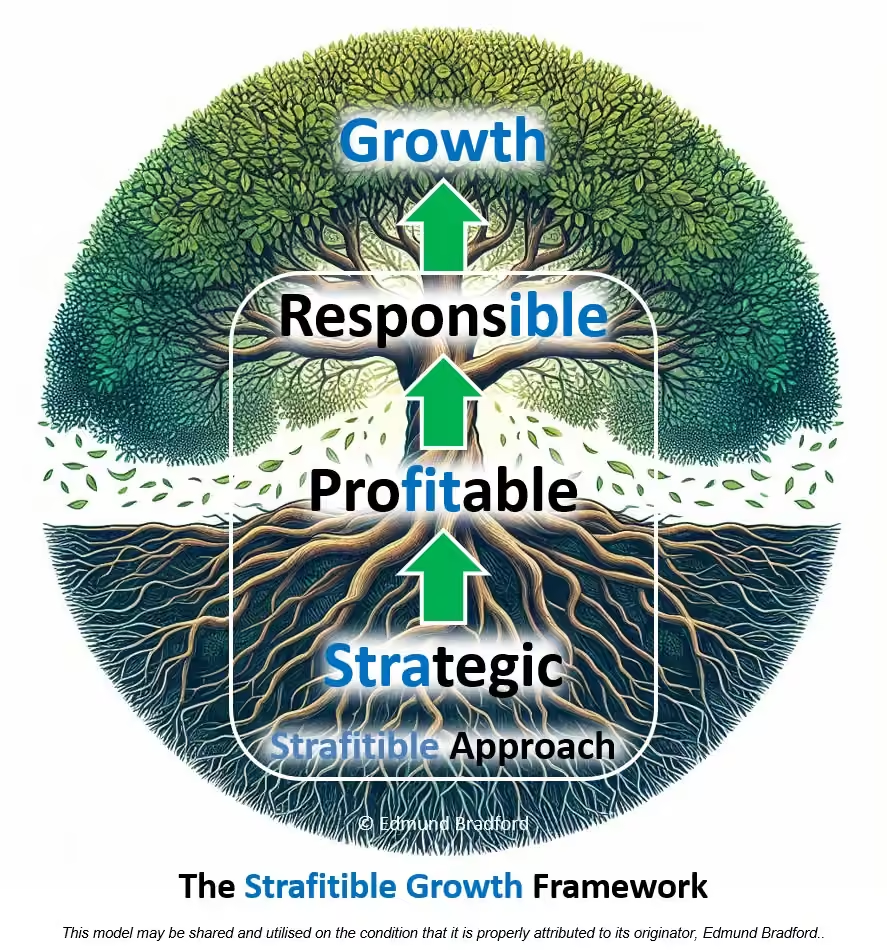
Strafitible Growth is a business framework that explains how to achieve sustainable business growth. As such, it is of immense value to any business that wants to be on a better growth path. It utilizes the business tree model that we have discussed previously and uses three important enablers: Strategic Roots, a Profitable Trunk and a Responsible Crown.
A Better Definition
‘Sustainable business growth’ is a type of business growth that combines improved financial health, improved social progress and greater prosperity while simultaneously reducing the business’s impact on the environment. It is connected to responsible leadership, ‘Good Growth’ and The Triple Bottom Line thinking of Savitz1.
However, although this is very laudable, the key question is, how can a business achieve it?
This is where the Strafitible Growth Framework fits in. It provides a systematic approach to achieving sustainable business growth. In other words, a Strafitible Approach drives Sustainable Business Growth. Both the approach and the growth outcome are captured in the framework.
A Definition of Strafitible Growth
It is defined as follows:
“Strafitible Growth is the strategic, profitable and responsible expansion that meets stakeholders’ needs today and in the future. It is anchored in deep strategic roots, which build a robust profitable trunk to fund a responsible crown of improved environmental and human equity, while extending a positive impact across the business ecosystem.” 2
So, it is balanced growth across financial, social and environmental arenas. The business should meet stakeholders’ needs over time and not sacrifice long-term growth for short-term demands. Its growth impact should extend beyond the boundaries of its own walls to the broader ecosystem. The definition also provides guidance on the process to achieve it through different structures.
Strategic Roots
From published research, our research and our experience over 30 years, we have identified 12 strategic roots that are major drivers (enablers) of good growth. These are:
Therefore, the strategic roots can be listed as 12Ps. These do not replace other factors listed in other business models. However, these are the key factors for business leaders to get right. They are the main channels for converting resource inputs into good growth outputs.
Successful companies tend to have some very strong roots amongst these rather than having excellent roots everywhere. For example, Lego has great partnerships with other brands, 3M has an excellent innovation pipeline, McDonalds and Amazon have excellent value propositions, Patagonia has a strong environmental purpose etc.
The 12P roots connect to the other 4Ps of the framework: Profits, Planet, People and Prosperity. This means the entire framework consists of 16Ps in total. While the roots may be hidden, the other 4Ps are much more visible.
Profitable Trunk
The strategic roots feed the Profitability of the business and strong roots drive high profits over the long-term.
There is ample evidence to support this both in academic research and in specific company case examples. Let’s look at two companies who were both transformed over the same, long 14-year period.
The first is Apple. When Steve Jobs returned to the helm in 1997 he set about developing an excellent innovation pipeline of world-beating products linked to a strong market strategy. Under Tim Cook (2011 to 2026) this morphed into the company having excellent business processes that deliver its “fast follower” strategy. By having these excellent roots in place since 1997, it has maintained long-term profitability and had built a cash pile of nearly $36 billion dollars in 2025.3
Another example is Tesco in the UK. When Terry Leahy became CEO in 1997 he set about turning the business around. This was done with 10 key words4 and was instrumental in changing the prevailing culture to being more honest, loyal, courageous, values-based, execution-focused, balanced and trusting. Over 14 years under his leadership, these strong roots helped enable Tesco to become the UKs largest retailer and one of the largest in the world. Indeed, operating profit grew from £774m to £3.4billion at the point he retired (in 2011).5
Let’s take a more recent example from the world of sport: the football (soccer) Premier League in the UK. Sports clubs are a great benchmark to study good growth. They are businesses in a very transparent and competitive market. Aston Villa are one of the oldest clubs in the Premier League. Today, like all clubs in the League, it must have sound financial health and keep to the Profitability and Sustainability Rules (PSR). Its financial growth has been driven by its market strategy of becoming a premium brand. It has invested in improving its stadium (Villa Park) to improve the fan experience and deliver more events (both sporting and non-sporting). It has also grown its sponsorship income and expanded its global brand presence. This has been a successful market strategy alongside success on the pitch. Aston Villa turned losses of £119.6m in 2023 to profits of £17m in 20256 … and it won the UEFA Europa League Cup in May 2026.
In our Strafitible Framework, sustainable profits is represented by the tree trunk. A business that is strong financially is represented as having a strong trunk. It can withstand the winds of change and distributes financial nutrients to the different branches of the business.
Responsible Crown
A strong, sustainable financial position allows the business to invest more in responsible programmes including both social and environmental initiatives.
Using the Triple Bottom Line thinking, we can categorize these programmes into three broad types:
• Planet-based programmes (e.g. carbon reduction, natural land use and water use)
• People-based programmes (e.g. training, pay levels and equality, health and wellbeing)
• Prosperity-based programmes (e.g. community support, wealth generation)
These are the visible outcomes of sustainable business growth. They are the activities that help the business make a positive impact on the world. They are the leaves (and fruit) of the sustainability efforts, absorbing resources from the business and improving the world around it. This can be seen as the crown of the tree, full of leaves that help life and the environment.
Again, sports clubs are good examples of businesses that try to achieve sustainable business growth. They tend to work hard to improve their social impact in their local communities. Their businesses also contribute to both local and national prosperity. The Aston Villa Foundation’s purpose is to “Use the club as a vehicle to positively impact local people, neighbourhoods and communities.” The Liverpool Football Club Foundation claims to have helped 145,000 people last season and deliver £80m of local social value.7
Within the last few years, sports clubs have also become keen adopters of environmental initiatives. Aston Villa has a Claret, Blue and Green environmental commitment which aims to reduce the clubs carbon footprint through electrification, better energy efficiency, rainwater harvesting, public transport partnerships, more local catering, food emission labeling and education initiatives. Aston Villa Football Club’s stated intent is to focus on “delivering sustainable improvement both on and off the pitch” and to “Build long-term sporting success alongside financial sustainability and organisational growth.”
Assessing the impact on national prosperity, it is estimated that the Premier League contributes over £4 billion in tax revenues and 90,000 jobs to the UK economy. Moreover, the sports industry as a whole contributes around £100 billion to UK economic prosperity (which is around 2.5% of total UK GDP).8
The Strafitible Growth Model provides 16Ps to help analyze any business and its capability to deliver long-term sustainable growth. It builds on earlier models developed by the author and provides a more comprehensive assessment of the roots for success.
Sustainable business growth is not just exhibited by a growing company with green credentials. It is a whole business model that delivers a broad range of sustainable outcomes driven by strong strategic roots. It is therefore right to say that such growth is also strategic, profitable and responsible.
A business with strong profits but poor strategic roots is like a tree in shallow ground: good looking but vulnerable to the next big storm that comes along. Companies like Tarmac that were still paying healthy dividends shortly before they fell, fit into this category.
A business with poor profits but a strong responsibility focus is like a tree with a large canopy but a weak trunk. That business also looks good from the outside with some great sustainability initiatives. However, after achieving past growth, its fundamental structure has decayed from years of decline. It also is at risk from falling, either from deterioration or the next big storm. Companies like The Body Shop fall into this category.
A business with good financial growth but poor socio-environmental growth is like a tree with some good roots and a strong trunk but a small canopy. It is in no danger of falling but it is also not contributing much to the world. Highly profitable but polluting and exploitative companies fall into this category. These companies can be found in many industries including agriculture, constructions, oil & gas, manufacturing, mining and textiles.
Finally, on an optimistic note, a young business with good strategic leadership is like a young sapling, developing good roots for the future. With good leadership it will grow into a recognized brand that exhibits the right characteristics of sustainable business growth, like a mature flourishing tree: strong, healthy and a force-for-good in the world.
So, think of any business and ask, “What type of tree is it?” The answer will help you understand how strong it is and how useful it is to the world.
Notes