







Summary
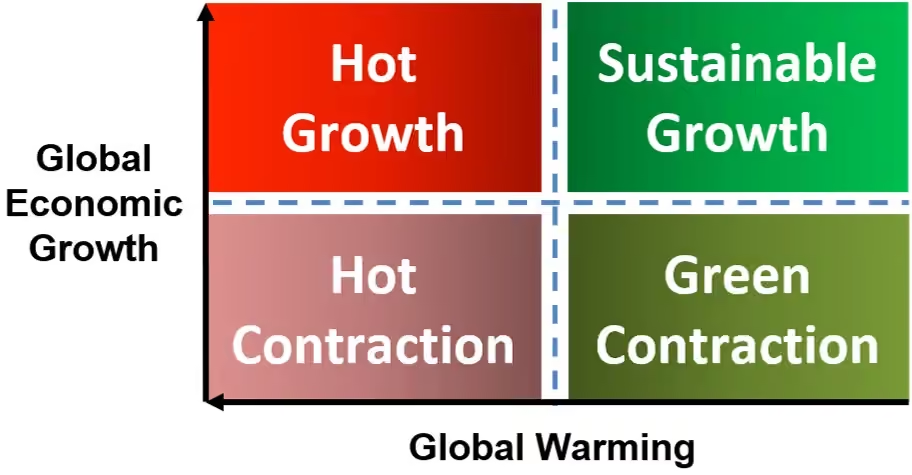
We appear to exist in two parallel worlds. In one world, more economic growth is better because it shows a thriving global economy. In the other world, reduced growth means less pollution and a thriving planet. What happens if we have one and not the other, both, or neither? To help understand this, I have developed The 4 Futures Model. This helps to understand how our world could evolve in the future. It also contains a warning about chasing economic growth without addressing the environmental consequences of it.
My inspiration for this model comes from an original idea by John A. Lanier in his and Ray C Anderson’s excellent book, Mid-Course Correction Revisited. In there he describes three different economic futures linked to global warming.
I have developed this idea into four futures linked to other research and relevant data. It is best used by picking any future year and plotting that year on the model. Multiple plots over multiple years show the direction of travel.
The 4 Futures Model
The model is designed to understand different global futures based on economic growth and global warming up to the year, 2050. Let’s first understand the two axes.
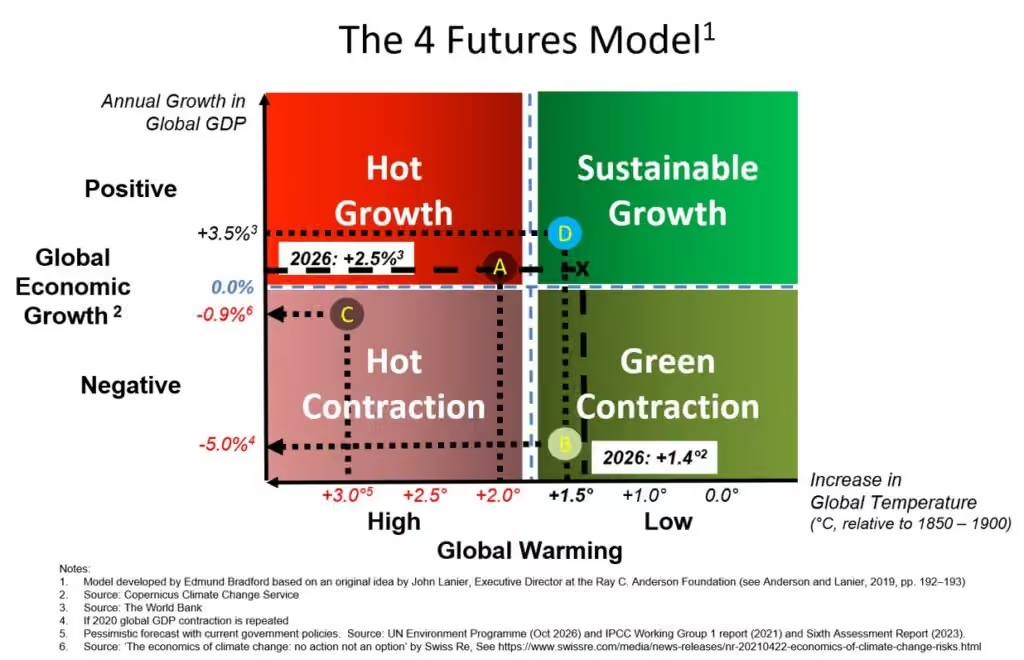
The horizontal axis shows different levels of global warming, with low levels on the right and high levels on the left. The axis shows the increase in global temperature (in degrees Celsius) for any year, relative to the years 1850 to 1900. This is the standard reference timeframe, commonly referred to as the “pre-industrial levels.” For 2026, global temperatures are forecasted to be 1.4 degrees above this base level.
The vertical axis shows the level of annual global economic growth, based on global Gross Domestic Product (GDP). In 2026, The World Bank expects the global economy to grow by 2.5% compared to 2025. This is below the 3.5% average annual growth since 1961 and slightly below the 2.8% experienced in the last 10 years (2015 to 2025).
Future 1: Sustainable Growth
Point X on the model shows our current position with temperatures this year forecasted to be 1.4 degrees above pre-industrial levels and economic growth for the year forecasted to be 2.5%. This puts us currently in the corner of the Sustainable Growth quadrant.
If we can maintain global warming at this level and maintain – or increase – global economic growth, then we should enjoy a golden era of sustainable growth in the future. This is what John Lanier describes as “sustainability with endless growth potential.”
According to Professor Kate Raworth (author of Doughnut Economics), this is where society and the environment are thriving and we exist in the “safe and just space for humanity.” We are keeping a lid on global warming by taking effective mitigation actions such as transitioning to clean energy, protecting carbon capture ecosystems and being more energy efficient.
Future 2: Hot Growth
We are currently sitting on the edge of acceptable global warming with just 0.1 degrees separating current temperatures from the 1.5 degrees set as the key international target under the COP21 Paris Agreement of 2015. Every fraction of a degree above that is seen as increasingly dangerous. The Paris Agreement commits countries to keeping warming “well below 2 degrees.” In our model, we have drawn the line between high and low levels of global warming at 1.75 degrees, which is halfway between the two targets.
Point A on the model is where we will be if we maintain economic growth at the current level but global warming creeps up to 2 degrees. In this case, or if either metric rises, we will be experiencing Hot Growth.
To maintain growth while the planet is heating up, we must execute effective adaptation strategies. This means that we are adapting well to the effects of climate change by developing new crops and new innovative solutions. We are also improving our buildings to cope with higher temperatures. We are building sea walls to keep our populated areas safe from rising sea levels. These add up to us developing resilient economies that cope well with high levels of global warming whilst improving social foundations and general wealth.
However, the higher global warming is, the more it will impact economic growth. Extreme weather and sea temperatures affect everything from food and water scarcity to supply chains and human productivity. According to a 2026 IMF study, recent extreme-weather events typically reduce annual economic growth in affected economies by around 0.1–0.2 percentage points, with severe events reducing growth by 0.5 to 3.0 percentage points.
So, in the short term, we might see the global economy growing despite global warming. However, in the long-run, more extreme weather events puts more downward pressure on the global economy and, unless we adapt even more, it could slip into recession and fall into the Hot Contraction quadrant. This is the hot boom and bust scenario.
Future 3: Green Contraction
Economies, of course, can grow and shrink independent of global warming. This century has seen several economic booms and shocks driven by such events as a banking crisis, covid, war and AI. For example, in 2020 during Covid, the global economy shrank by 5.2% while global warming stood at around 1.25 degrees for the same period (well below the 1.5 degrees Paris target). So, in this year, we experienced a Green Contraction.
This is where environmentalists who advocate “de-growth” would like us to be: putting planet above profits. Their argument does have its merits. It is estimated that the 2020 global recession reduced energy-related emissions by 5.8%, the largest decline since the Second World War. However, in addition to individual tragedies, there was a large economic cost with around 114 million jobs lost globally and global labour income falling by 8.3%. Government borrowing also soared, which many populations are still paying for today through their taxes. So, green contraction may be good for the planet, but not for many people. John Lanier describes this as “sustainability that becomes growth agnostic.”
Point B on the model shows where we would be if global warming was limited to 1.5 degrees but another large-scale shock such as another pandemic were to occur, with a rapid fall of 5% in global GDP. We should note that with a pandemic this may only be a temporary contraction, but with a longer term shock, such as a major war or financial crisis the contraction could trigger a broad depression.
Future 4: Hot Contraction
We have seen above how the global economy can affect global warming. The forces can also run the other way. A very interesting report was done in 2021 by the international insurer, Swiss Re, about the impact of global warming on global growth. It concluded that “If no mitigating action is taken, global temperatures could rise by more than 3°C and the world economy could shrink by 18% in the next 30 years.” This equates to an annual decline of around 0.9%. Therefore, in this scenario, we would have a double whammy of rising temperatures and a contracting global economy. This is point C in the model, which sits in the Hot Contraction quadrant.
An economic depression (i.e. long-term economic contraction) could also be caused by other forces. These forces include prolonged trade wars, actual wars, cyber-attacks, pandemics and ageing demographics. So it is quite feasible that mankind ends up in this, the worst future of all, what John Lanier called the “crash” scenario.
Applying it at a National Level
Although the model is based on global data, it can also be applied to individual countries or economic areas (such as the EU). In this case, local data can be used for both axes. On the horizontal axis, the local increase in temperature from global warming would be used. On the vertical axis, the local economic growth data would be used.
We would therefore see what the future holds for different economic areas and we may find different areas located in different quadrants simultaneously.
A Positive Note on Which to End
Point D on the model shows our position if we can limit global warming to 1.5 degrees and return to annual global growth of around 3.5%. It shows that we shall remain in the good zone of Sustainable Growth. That means our planet, people and profits will continue to thrive, long into the future.
The dangers are near and many fold. To avoid them, we all need to play our part. The politicians and their representatives may set the targets but it is us, the consumers, employees, entrepreneurs and volunteers who will deliver them. As the British polar explorer, Robert Swan put it, “The greatest threat to our planet is the belief that someone else will save it.”